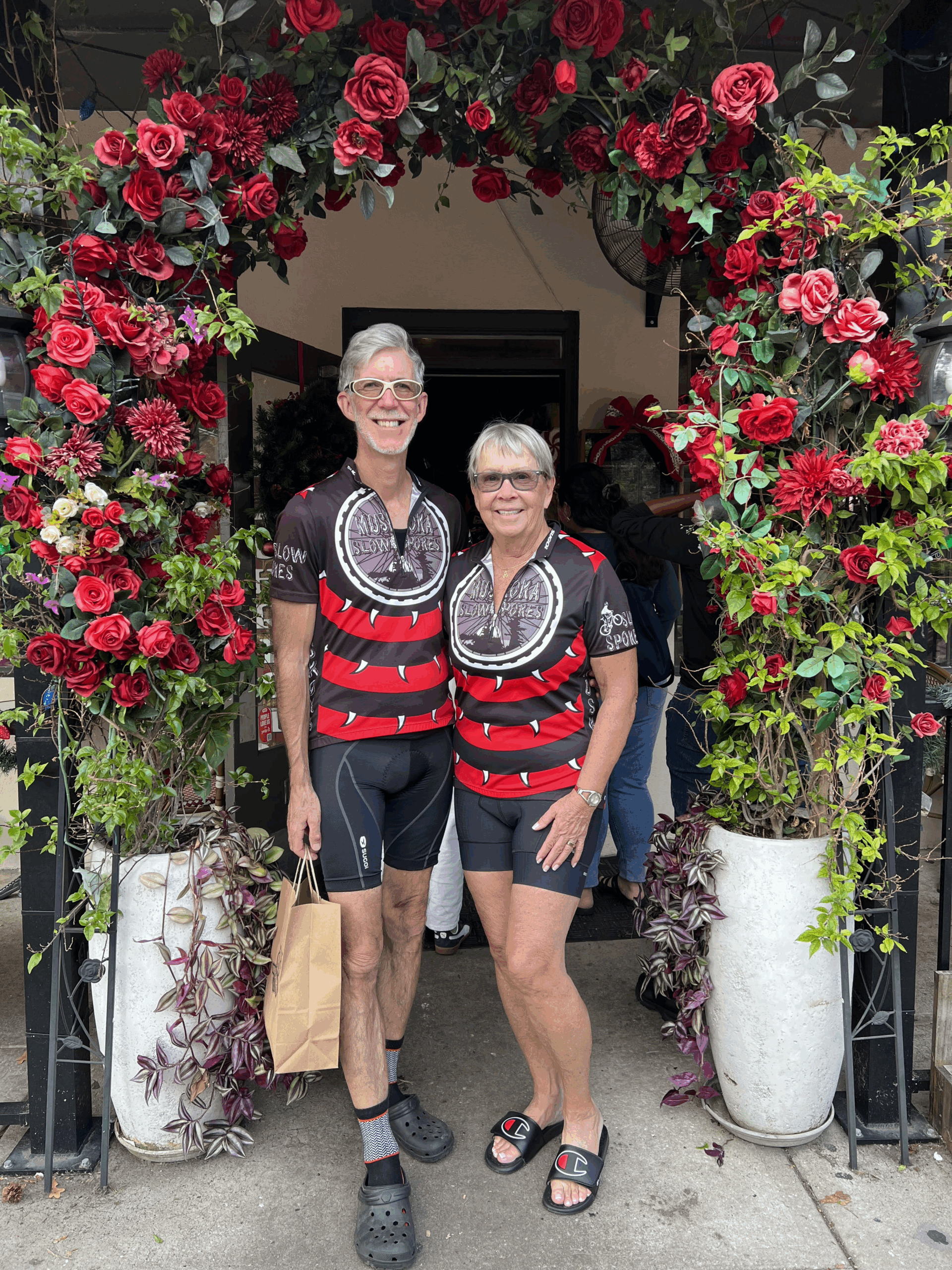
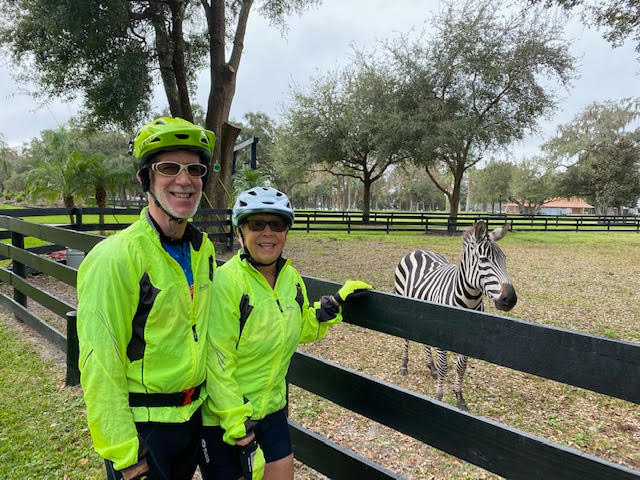
Sharing the amazing story of my good friend Arienne Cripps from Stouffville, Ontario, Canada. I have had the privilege of meeting Arienne and her physician husband John at several conferences focused on low carb nutrition. John and I published paper together in 2023
Look in or book in: The case for type 2 diabetes remission to prevent diabetic retinopathy
https://insulinresistance.org/index.php/jir/article/view/79/248
…………….
…………………………
Personal Story and Recovery Journey
Can you describe what your life was like before the stroke?
Before my stroke, I was very physically active with cycling, hiking, Line Dancing, weightlifting, and spending time with my husband, kids and grandkids. The day before my stroke, I completed a 9 1/2 mile walk with my husbandJohnnear our Florida home
What do you remember about the stroke and the days that followed?
I remember John coming back into our bedroom and asking me if I wanted to have my coffee. As soon as he looked at me, he realized I was having a stroke, called 911, and after that there were seven paramedics in our bedroom within minutes. I was unable to speak and paralyzed on my right side. Once they secured an intravenous they took me to the local hospital. I don’t remember much else until 1:30 AM the next morning. John was asleep at my side and I thought a nurse was at the foot of my bed. It was my stepdaughter who flew 1500 miles immediately after learning of my stroke. I was surprised and delighted to see her.
My next memory was on Day 2. My primary care nurse told me PT (physiotherapy) and OT (occupational therapy) would be coming to see me. It was an assessment to see if I could move, speak, or sit up. Later that day another unexpected surprise with my two sons, one daughter-in-law, and three grandchildren walking in the room. I never expected anyone to stop their busy lives and hop on a plane.
On day 3 a “really big muscular dude”i.e., the new physiotherapist came into my room. “Do you want to get up out of bed and try walking?” Nurses had a walker to help me since I couldn’t move my right leg but he pushed it along with his foot. Returning in the afternoon for another walk he said “forget the walker, you won’t need it”. “I’ll hold you up with this physio belt”. I looked at him again and thought there was no way this Arnold Schwarzenegger like guy would drop me. I walked with him to the nursing station and back and was elated. I walked with him twice as far the next day then my husband took over walking me with the support belt.
Kids and grandkids were at the hospital daily and my goal was to “escape” the acute care facility as soon as possible. By day six I received medical clearance and headed to a rehabilitation hospital for additional treatment.
I was so determined to go home from the rehab unit I worked extremely hard with my physiotherapy and occupational therapy teams and was out after one week.
What were the biggest challenges in your recovery, physically or emotionally?
I think I was afraid that I wouldn’t be able to get back to the person I was before the stroke and therefore I needed to work very hard and I had the determination to do that. Every once in a while my physical progress would stall or go backwards and this induced some anxiety, fear, and I was suddenly riding an emotional roller coaster.
Did you ever lose hope? What helped you stay motivated?
Yes, I did particularly early on when I was in the rehab center. A friend of mine on FaceTime told me to get the book by Dr. Jill Bolte Taylor; “My Stroke of Insight: A Brain Scientist’s Personal Journey” – detailing her experience of a massive stroke at age 37 and her eight-year recovery process. I found her second book “Whole Brain Living: The Anatomy of Choice and the Four Characters That Drive Our Life” written at age 62 more useful for recovery. It’s “whole brain living” I look to whenever I feel that there is not much hope to make any more improvement. If I really slip into a dark hole and am going off the deep end, my always positive, optimistic , and supportive husband has a way of pulling me back up the cliff.
………………
Lifestyle and Nutrition
What was your way of eating during your recovery?
In the acute care hospital the Standard American Diet was the only choice. By “special request“ I told them I was Keto and they would send me food that resembled “meat“ on a pile of mashed potatoes, always with a “dessert“ which had 23+ ingredients followed by … and more written on the ingredient list!
Needless to say, I never had a single bite of any of the food in the hospital and my husband brought me a 32 ounce mix of KETONES every day once I was able to drink a little starting around 48 hours. In addition, my son‘s or husband would cook a lot of steak for me, cut it up, and bring me my food each day. Occasionally I would have cheese and Avocado in addition.
In the rehab centre I told them I don’t eat veggies, sugar or fruit yet every day they offered me cookies, puddings, Jell-O, etc. I think a made an impression by only eating burger patties the entire time.
Once at home by day thirteen I remained on my low carb diet, mostly under 30 grams total carbs. I enjoyed occasional Macadamia nuts with salt, and ate beef, butter, bacon, and eggs to satiety while upping my exogenous ketones to twice daily.
Did your diet change from before the stroke to now?
OF MAJOR IMPORTANCE WAS THE ADDITION OF EXOGENOUS KETONES. Otherwise my Diet remained identical to what I was eating prior to my stroke. The only change I made was dropping my once enjoyable, 5 ounce glass of red wine once or twice a month because the neurologist told me that zero alcohol would allow the fastest recovery.
What kinds of meals do you typically eat in a day now?
I normally eat two meals a day, and occasionally one meal a day (OMAD)all within a 6-hour window. I am mostly 95% CARNIVORE but will have occasional celebratory treats with grandchildren’s birthdays.
Exercise and Movement
How did physical activity factor into your recovery process?
OMG. That’s a huge question. When forced to return to Canada following withdrawal of my medical insurance within 24 hours I was out in the driveway shoveling snow. My husband, then suggested that I restart high intensity weight training (HIT) with a previous trainer we went to in the early 2000s. The author of multiple books, documentaries, and a deep knowledge of exercise physiology, John Little took a very cautious approach to my rehab following consultations with multiple physicians familiar with post stroke programs. I love my 15 minutes of HIT and have increased my strength 100% over two months.
What types of movement or exercise do you do now?
I walk 2-3 miles daily, line dance twice/week, and cycle on a tandem both off-road and on road. The HIT is a mix of squats, leg press, leg extensions, and push and pull exercises for the upper body. Throw in back extensions and the abdominal machine and I’m definitely out of gas when I leave John Little’s gym. Seeing my weights consistently increase is an absolute bonus for my mental status.
How do you stay consistent with physical activity, even on hard days?
Normally, my husband and I motivate each other for physical activity. If my husband is out, I now prioritize time for myself over other chores I think I need doing in the house. Finally, I am putting myself first in my 80th year.
Mindset and Emotional Strength
What mindset shifts did you have to make during your recovery?
One of the most important things I learned was to concentrate what I could do and not what I couldn’t do or could previously achieve 30 years ago as an example.
I am also working on mindfulness or being in the present moment.
What role did faith, family, or community play in your journey?
Spirituality is a very important aspect of my recovery. Being outside in nature is very soothing and peaceful for me.
When line dancing in our community people have come up to me asking me to speak to their friends to motivate them post stroke because they see my drive and motivation. Two weeks ago my husband and I put on a session in our community center called “Concentrate on the Positive”. We had many residents sharing stories of strokes, brain tumors, ALS, major traumatic injuries, and how they overcame these hurdles. Being in a supportive social environment is powerful medicine.
What advice would you give to someone facing a major health setback?
Baby steps, one day at a time, concentrate on small things that you can do, and if you find it helpful, write down and celebrate your successes no matter how small you may feel they are. Surround yourself with family and friends who are supportive and positive. Avoid those who are negative because it is not helpful to your emotional or physical well-being.
Reflections and Looking Forward
How do you feel today, compared to where you started?
I feel really good because I’m now finished my barrage of consultations and diagnostic tests, and I continue to improve each week possibly due to sheer determination.
If I’m fortunate enough, I would love to see my grandchildren, married, and perhaps be a great grandmother someday as well.
What are you most proud of about your recovery?
The fact that early on after my stroke, I couldn’t write or even open a can but now I am regaining immense physical strength and can perform several tasks with a little effort. Sure, I may get tired a little sooner and perhaps I can’t ride 60+ miles on the tandem but can manage 25-40 miles and be proud of that. So overall I guess my best answer is I’m proud of my physical strength.
What are your goals or dreams now that you’ve come this far?
I’m going to put in maximum effort to stay as healthy as possible for as many years as possible.
If you could go back and tell yourself one thing right after your stroke, what would it be?
I would definitely get a handle on my stress load, both professionally and with family related matters.
Advice for Others
What would you say to other older adults who think it’s “too late” to change their health?
It’s never too late to get stronger. You have to start somewhere and beginning with tiny, incremental steps strength training can quickly add up for people of any age.
How did your healthcare providers react to your low-carb/exercise approach?
Nearly all my physicians agreed at best “to work with me”. This was despite my comments from the doctors saying; “I’ve never seen a patient of any age with a major stroke make such a remarkable recovery”. They had no interest in looking at the root cause nor curiosity surrounding my use of intermittent fasting, exogenous ketones, or strength training.
Finally an open minded stroke sub specialist asked me to come to a major educational event next year for residents, neurologists, and patients. He asked to present my case because “you are a model patient showing what is possible”.
What resources or tools helped you the most—books, people, programs?
Books
Benjamin Bikman:
Why We Get Sick: The Hidden Epidemic at the Root of Most Chronic Disease—And How to Fight It
How Not to Get Sick: A Cookbook and Guide to Prevent and Reverse Insulin Resistance, Lose Weight, and Fight Chronic Disease
Doug McGuff and John Little:
Body by Science
The section on strength training for seniors is excellent. The book’s central premise is that optimal fitness can be achieved through a high-intensity strength training program requiring just 12 minutes per week.
Gary Fettke
Inversion: One Man’s Answer for World Peace and Global Health
Jill Bolte Taylor
My Stroke of Insight: A Brain Scientist’s Personal Journey
Whole Brain Living: The Anatomy of Choice and the Four Characters That Drive Our Life
People
Any positive friends or family who are supportive of what your goals are.
Some Images of the Recovery
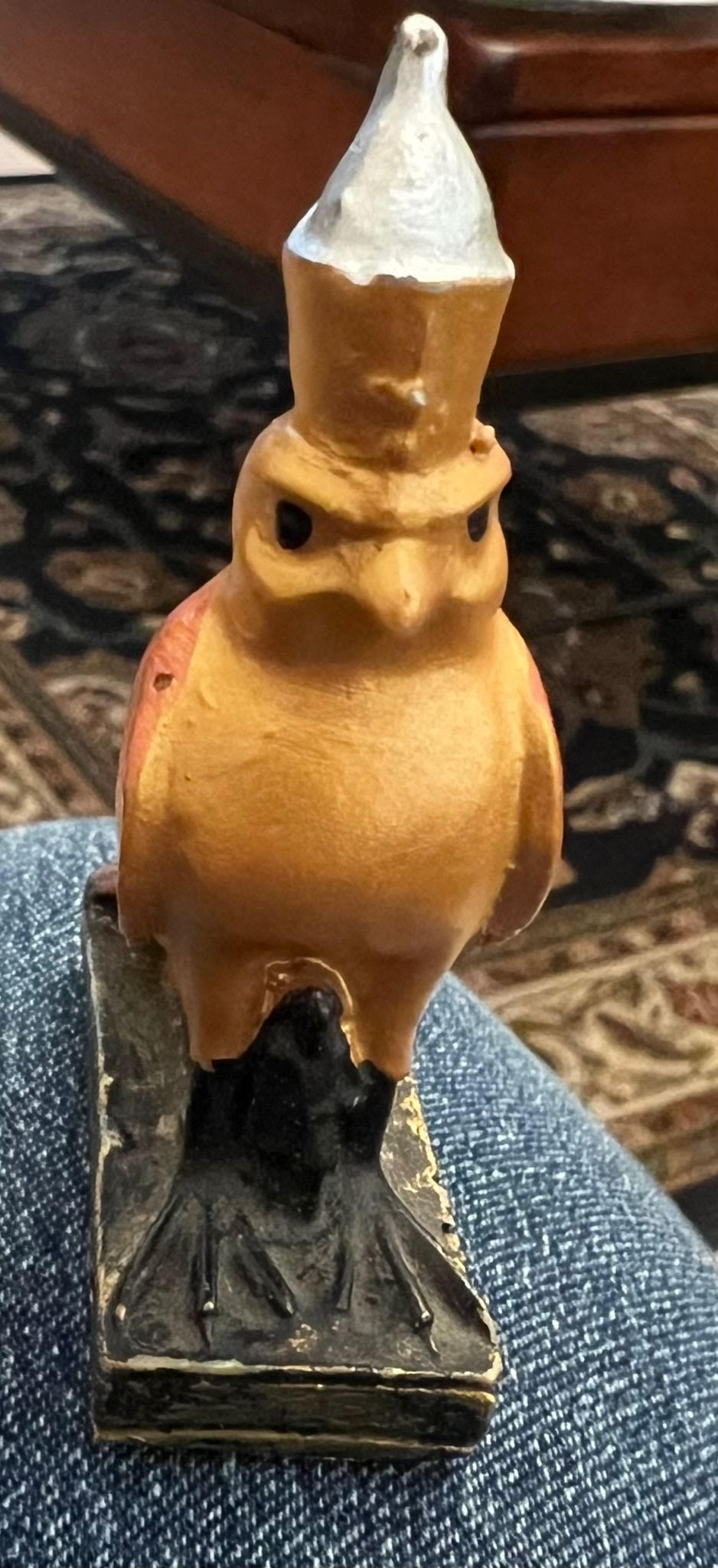
My youngest son was lecturing other PhDs & physicians in Arizona when my husband phoned all the children. He was visibly shaken and a colleague of a different religion calmed him down while others helped arrange a flight to Florida. He then gave my son this statue of a bird and told him “bring this to your mother and everything will be alright”
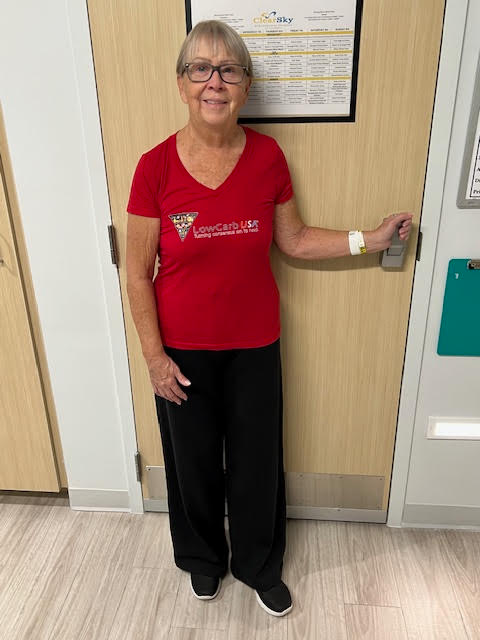
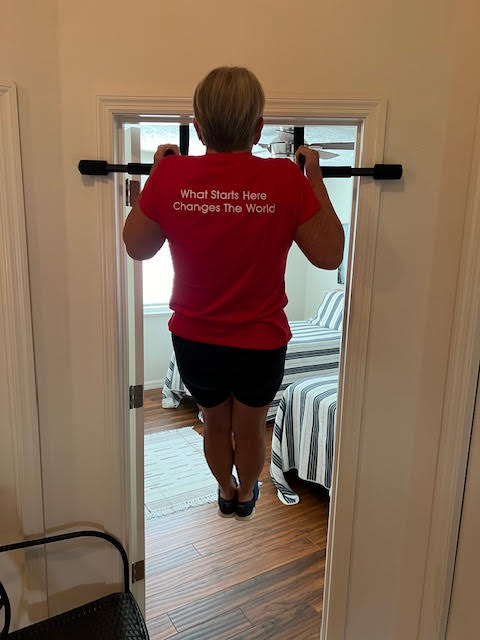
This was my first day in the rehabilitation hospital. I have a little movement of my right arm and leg but need to hold onto the doorway with my left hand due to weakness and no balance
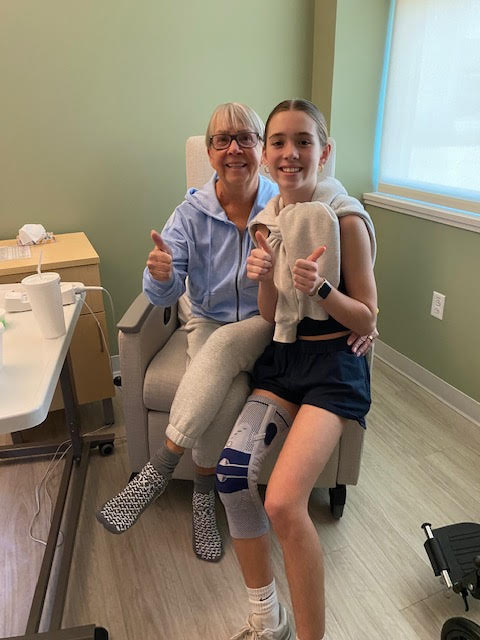
STROKE DAY 8
I was excited to move my right hand so my athletic granddaughter visiting me was thumbs up for this picture
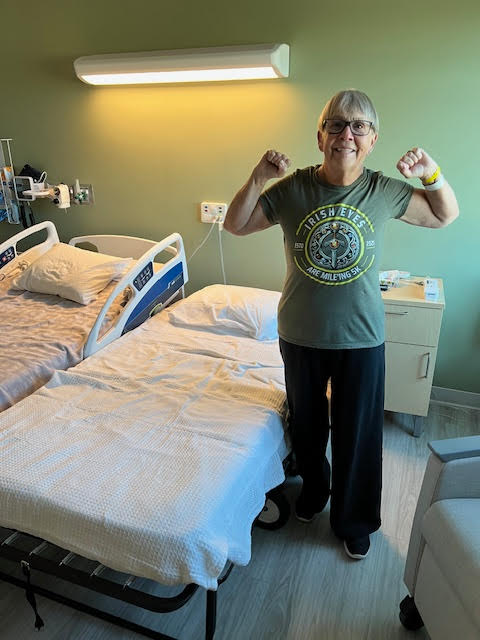
STROKE DAY 10
My husband John was always at the rehab center from early morning until late at night. Unknown to me he had arranged with the administrative staff a “date night” where they brought in a child’s folding bed for him to “sleep” overnight. He held my hand all night long. I am wearing a 5K running shirt from the previous year when I was the oldest female in the race. I was signed up to run it again before my stroke. The organizer, after learning of my condition, refunded my money and graciously sent me the most beautiful get well card along with his thoughts and prayers
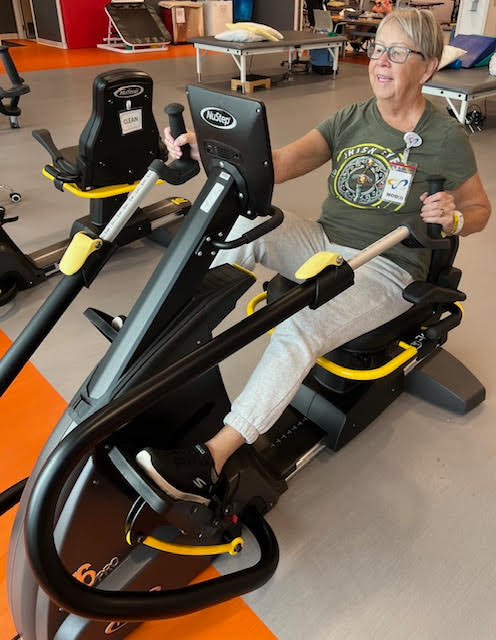
STROKE DAY 11
My physiotherapist was outstanding and realized how driven I was to get out of the rehab hospital in the shortest time possible i.e., 7 days. Whatever she asked of me I requested to do more.
I was released from the rehab hospital after 7 days. The rehabilitation medicine sub specialist told me he wished all his patients could be motivated like me. I told him I worked this hard so I could go home.
STROKE DAY 14
I had been blessed with the kindness of neighbours in my Florida community. When all my children and grandchildren flew down to see me our friends and neighbours brought bedding, blow up mattresses, and food for my family.
I was home on Day 14 post stroke and was still unable to write. Flowers and get well cards were also piled up at my doorstep. The family flew back home to resume their busy lives.
When I was first able to speak some understandable words in the acute care hospital I looked at my husband, and with tears running down my face told him “I will never dance with you again”. He looked at me and said “Yes you will”. We were ballroom dancers in the past and one of my favourite things to do was gliding across the dance floor with John.
So, I came up with a plan. Because I couldn’t write but could speak somewhat coherently I knew bingo night drew the biggest crowd at our community center. John phoned the organizer and asked for a couple of minutes to address the crowd, many of whom had helped us during my journey. I also told John — “I want you to record a waltz and dance with me”. John was afraid I would fall so I told him — “just lead me and if I fall I fall”!
I thanked everyone at bingo for all they had done for my family and then asked for their patience for 3 more minutes. John played the waltz on a portable speaker, I didn’t fall, and we both burst into tears after the song ended. We were surrounded by everyone in the room with a giant hug and there was no a dry eye in the house. The next day we took the long drive back north to Canada mandated by our insurance company
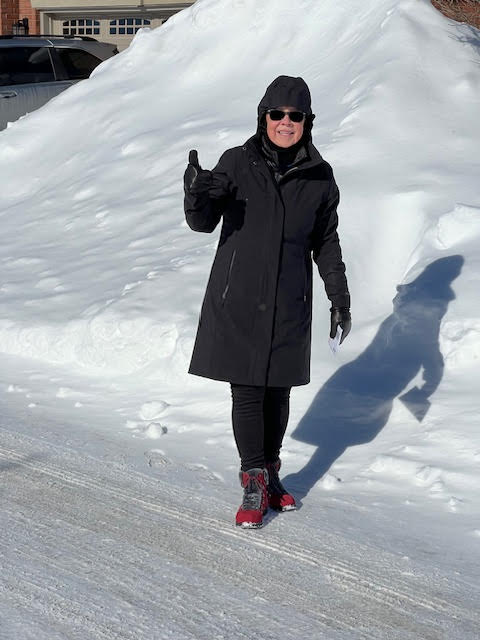
STROKE DAY 16
Two mile walk at -20 degrees
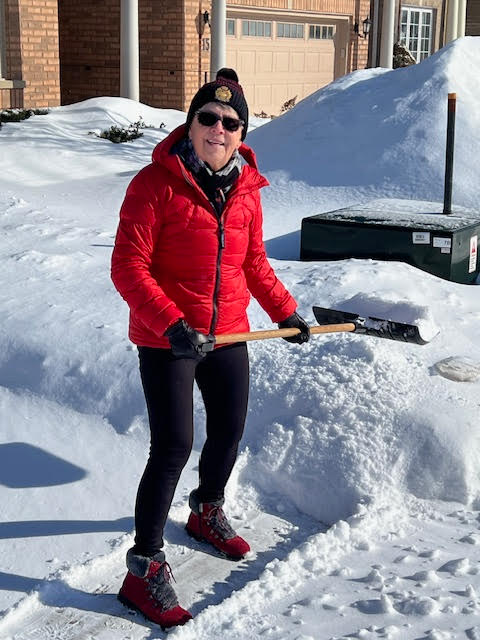
Shovelling snow at -25 for “rehab”
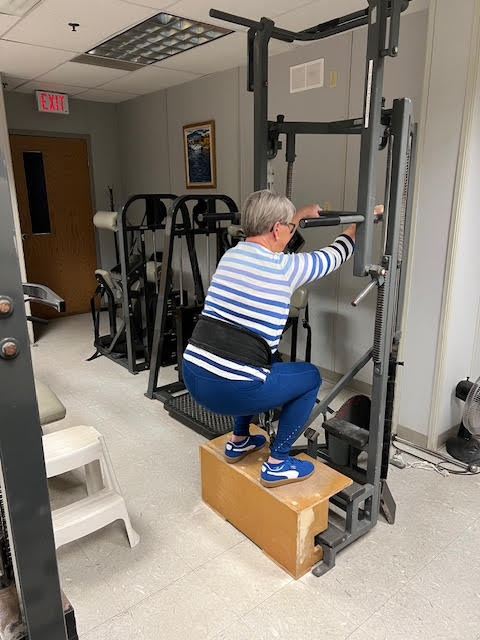
STROKE DAY 41
Starting HIT (high intensity training). No matter where you are in your journey getting stronger with give you more functionality .
I celebrate each and every day and try to remind myself to stay positive. I remain grateful to everyone who has been an active participant in my ongoing journey.
Health and Happiness,
Arienne Cripps 

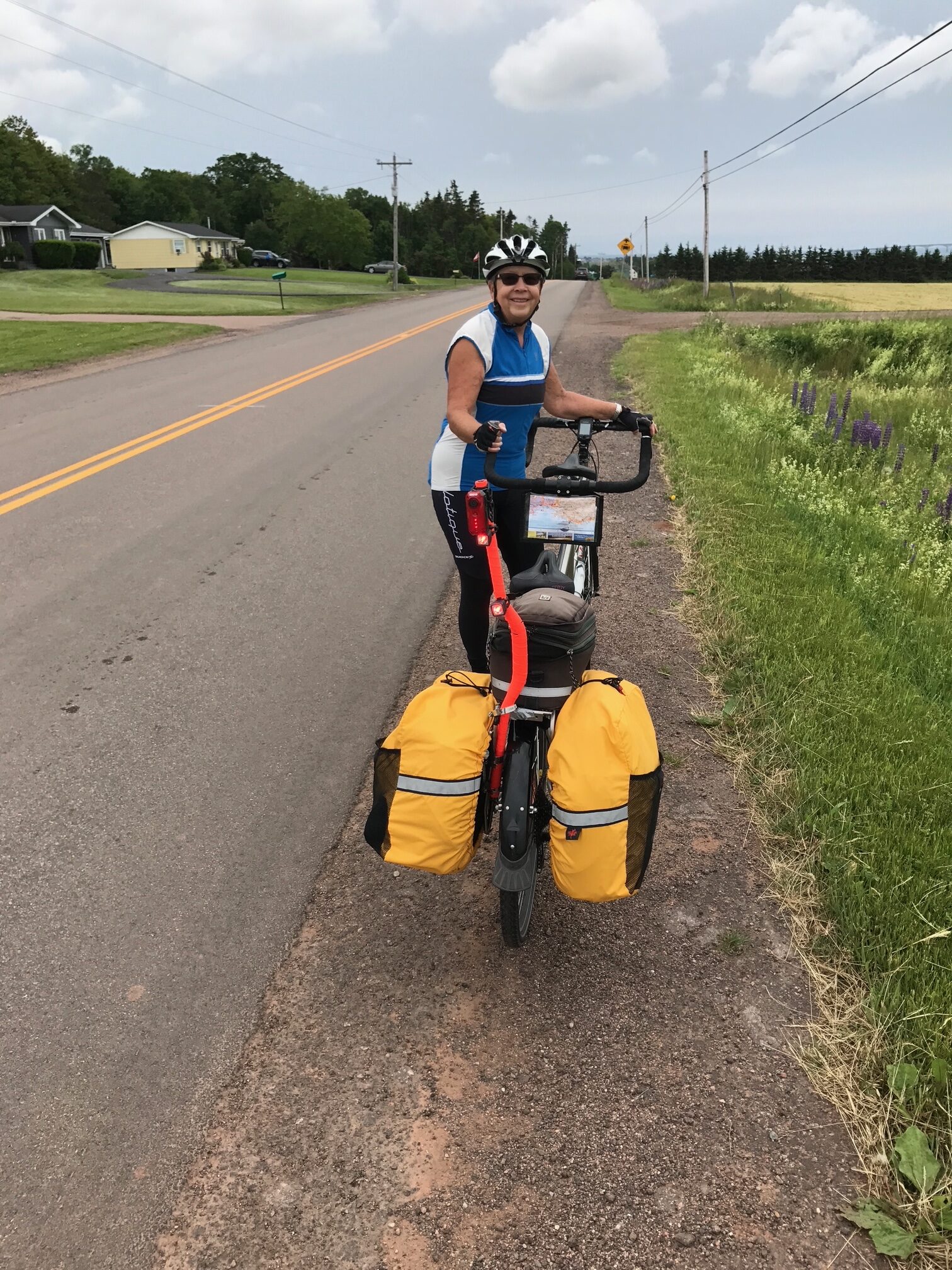
A few pics of John and Arienne on cycling adventures